Showing posts with label Touring Berlin. Show all posts

Friday, October 11, 2013

Fits on the Road: Exploring Berlin Germany: Part 3

By Jess in Minneapolis

Well, here I am, sharing memories from our final day of touring Berlin. (You can read parts 1 and 2 here and here) Part 3 is packed full of museums!

We were up early to get started, stopping quick for a frothy latte along the way, at a place called Die Deponie Nr. 3

Berlin has a cluster of museums close together on what is referred to as "Museum Island." There are more museums on there than the ones we visited, but we only had so much time! Fortunately, I believe we saw most of the highlights.

We started at the Pergamon Museum.
A large portion of Museum Island is currently under construction, so we were routed through an alternate entrance.

Once inside, you can't miss one of the world-renowned highlights, the Pergamon Altar. Built in the first half of the 2nd century BC, it was originally located on the acropolis of the ancient city of Pergamon.

"The structure is 35.64 metres wide and 33.4 metres deep; the front stairway alone is almost 20 metres wide. The base is decorated with a frieze in high relief showing the battle between the Giants and the Olympian gods known as the Gigantomachy. There is a second, smaller and less well-preserved high relief frieze on the inner court walls which surround the actual fire altar on the upper level of the structure at the top of the stairs. In a set of consecutive scenes, it depicts events from the life of Telephus, legendary founder of the city of Pergamon and son of the hero Heracles and Auge, one of Tegean king Aleus's daughters. 

In 1878, the German engineer Carl Humann began official excavations on the acropolis of Pergamon, an effort that lasted until 1886. The excavation was undertaken in order to rescue the altar friezes and expose the foundation of the edifice. Later, other ancient structures on the acropolis were brought to light. Upon negotiating with the Turkish government (a participant in the excavation), it was agreed that all frieze fragments found at the time would become the property of the Berlin museums." source


Next was the market gate of Miletus. This large marble monument is from the second century AD, destroyed in an earthquake in the 10th or 11th century, and then excavated and rebuilt in the early 1900s.


And the final "showstopper" (trust me, there was a LOT more to the museum, but these are three big ones) was the Ishtar Gate.  This was the eighth gate to the inner city of Babylon, constructed in 575 BC by order of King Nebuchanezzer II.

We spent about two hours in this museum, before moving along to the Neues Museum.


The "highlight" here was definitely the bust of Queen Nefertiti. There were no pictures allowed of her, but here is a picture from my good friend Google. She has a room all to herself at this museum. Special lady!

"The Nefertiti Bust is a 3,300-year-old painted limestone bust of Nefertiti, the Great Royal Wife of the Egyptian Pharaoh Akhenaten, and one of the most copied works of ancient Egypt. Owing to the work, Nefertiti has become one of the most famous women of the ancient world, and an icon of feminine beauty. The work is believed to have been crafted in 1345 BC by the sculptor Thutmose.
A German archaeological team led by Ludwig Borchardt discovered the Nefertiti bust in 1912 in Thutmose's workshop in Amarna, Egypt. It has been kept at several locations in Germany since its discovery, including a salt mine in Merkers-Kieselbach, the Dahlem museum (then in West Berlin), the Egyptian Museum in Charlottenburg and the Altes Museum. It is currently on display at the restored and recently re-opened Neues Museum in Berlin, where it was displayed before World War II." source

There was tons to see in the Neues Museum, including the Berlin Gold Hat, which is a late Bronze Age artifact made of thin gold leaf. It once served as the external covering on a long conical brimmed headdress.

And on to the next museum...the German History Museum, or "Deutsches Historiches Museum". 

This is a museum for "enlightenment and understanding of the shared history of Germany and Europe." 

This museum was huge, as it traced the entire history of Germany. It had a little bit of everything! Of course, there was a grand exhibit on the Nazi regime, and then the Berlin Wall. But we actually found the older history pretty interesting as well. 

I mean, where else can you find shields this big?

And what's a lesson in German history without my pal Martin Luther and his 95 thesis? 
We Minnesotans are usually fans of this guy.


I also found this mask fascinating. This was for protection from the plague!

Whew. So you'd think after all that museum time, we'd need a break?

Nope. Just ONE more museum to squeeze into the day. This one was small, but actually really fascinating. Throughout our stay in Berlin, we both became very curious about Communist life in East Berlin, and this DDR Museum shed some light on the topic for us.

Life in East Berlin was definitely unique...Just take a look at this little tidbit of information about the collective potty breaks at the daycares. No one stops until everyone is done!

There was tons of information about life in communist East Berlin, the black market between East and West Berlin, and even a Trabant, the popular car produced in East Berlin. 


We also saw the Berlin Cathedral, or the "Berliner Dom."


With that, you have a pretty good idea of our third day exploring. I definitely feel like we got a really good feel for the city. Of course, the pictures I have posted are mostly the tourist attractions. Yet in between all that, we were able to really explore some neighborhoods, stopping at many different places for a bite to eat or to check out an interesting store.

I fell in love with Berlin's "Ampelmannchen" or "little traffic guy" as well. He's the little symbol on their traffic lights. He has become a bit of a cult symbol now too, with stores dedicated to Ampelmannchen wares!

See now? Running isn't just about exercise. Thanks to running, we had this opportunity to explore Berlin, and learn about life (and history) of this funky city.

Wednesday, October 9, 2013

Fits on the Road: Exploring Berlin, Germany: Part 2

By Jess in Minneapolis

We started our second day of exploring in Berlin with full-body massages at the ONO Spa within our hotel, the Mandala Hotel.  They felt so great on our sore muscles, and when they were done, we were all set for more exploring.

We started the day in such a decadent and peaceful way with massages. It was a sharp contrast to what we did next. 

I understand that the following tour has nothing to do with Fitness, Fashion, or Fitness Fashion, but it made up a full day of our exploration of Berlin, so I am including it nonetheless.

We decided to take the train out to the suburb of Orangienburg, which is the site of a concentration camp called Sachsenhausen. Dustin had visited Dachau years ago, but I had never toured a concentration camp, and I think it's important to reflect on that part of our history. It was extremely moving, and I'm glad we decided to go, but it was not a destination for every kind of tourist.

Our first sign of the camp was this commemorative sign regarding the Death March of the prisoners away from this site, at the end of the war.
"This plaque was erected by the Communist GDR government, to commemorate the Death March undertaken by the prisoners of the Sachsenhausen concentration camp under the Nazi government. The GDR placed an emphasis on political prisoners over the other groups held at Sachsenhausen (Jews, Jehovah's Witnesses, Homosexuals), hence the pictured prisoners are wearing red triangles (the symbol for political prison" source


The Death March: With the advance of the Red Army in the spring of 1945, Sachsenhausen was prepared for evacuation. On April 20–21, the camp's SS staff ordered 33,000 inmates on a forced march northeast. Most of the prisoners were physically exhausted and thousands did not survive this death march; those who collapsed en route were shot by the SS. On April 22, 1945, the camp's remaining 3,000 inmates, including 1,400 women were liberated by the Red Army and the Polish Army's 2nd Infantry Division. source


All of the signs were first in German, and repeated again in English. We also rented audio guides, which were helpful. I noticed that there were some English speaking tours happening while we were there as well, and I believe they cost 12 euro. 
Entrance to Sachsenhausen

The sign on the gate at the entrance to the camp bears an inscription which can be seen on other gates at such camps as Dachau. Losely translated, it means "Work Sets You Free." 

I won't explain each part of the camp, as most of the pictures are pretty self-explanatory, though a lot of the information and learnings were all in the readings that they had along the tour. 

Most of the camp was destroyed by the Soviets, and then re-created with some original pieces.

It was interesting to read about the camp's prison. I mean, these are already prisoners within a concentration camp, but even within those dire straits, there are even worse conditions and punishments.

The Soviets built this memorial and it's notable due its inherent irony. It lists all of the countries from which victims of this concentration camp came. A Soviet soldier stands behind the prisoners, liberating them from their persecutors. But then Soviets used Sachsenhausen as a Special Camp for political prisoners until 1951 and during this time 12,000 more people died of starvation, hunger, and maltreatment here.

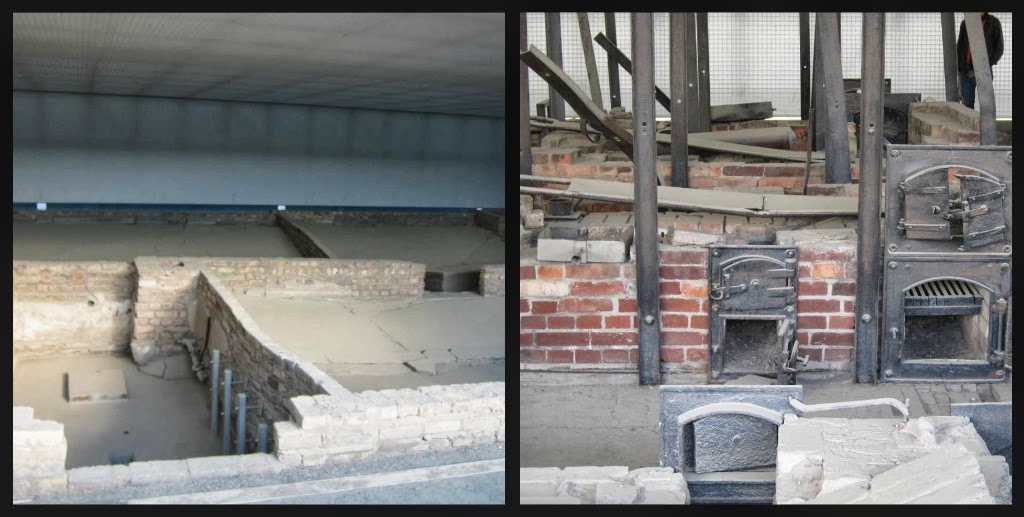
Of course, two of the most disturbing parts were the gas chambers and the crematorium.

Sachsenhausen was also the site for many medical experiments, some of which were explained in the prison's "infirmary." That portion of the tour was very disturbing.

Below is a picture of the execution trench.

Again, I'm glad we took this tour. It was disturbing and so sad, but it's unfortunately a part of our history that can't be ignored.

We were at Sachsenhausen until nearly 5 pm. As the sun started to set, we realized it might be a little eerie to be there after dark, so we were on our way back to the train station to head back to the city centre.

Once we were back in Berlin, we headed to Prater Garten Berlin, one of the oldest beer houses in the city. It's a "bier garten" institution, so to speak. Read a great review of this place HERE

Prater served up traditional German food, which is what Dustin ordered.

I went with something a "little" lighter with egg dumplings, spinach, and a tasty salad.
...and of course, there were some beers. This time instead of the Pilsner Radler (with sprite) we both ordered our beers "dunkel" or dark. Perfect!

And that, my friends, was our second day of touring Berlin. Stay tuned for our third and final day of exploring this city!

Tuesday, October 8, 2013

Fits on the Road: Exploring Berlin, Germany Part 1

By Jess in Minneapolis

The primary reason we were in Berlin last week was of course the Berlin Marathon. But post-race, we had a solid three days to explore this interesting city.

Monday morning, we were up early to walk over to the Reichstag building. If you recall, this building was close to the staging area before the marathon, so we had already taken a few pictures in front of it on race day.
Pre-marathon
Even though we had seen the outside of the building, we wanted the full tour. In order to do so, we had to pre-register to obtain clearance to visit. We had read that it could take over a week for an appointment, yet we heard back within twenty minutes that we were cleared. This could have been because we weren't trying to visit on the weekend; I'm sure the weekends are much busier. You can register online, but you will need your passport to register, and to obtain entry.

"The large glass dome at the very top of the Reichstag has a 360-degree view of the surrounding Berlin cityscape. The main hall of the parliament below can also be seen from inside the dome, and natural light from above radiates down to the parliament floor. A large sun shield tracks the movement of the sun electronically and blocks direct sunlight which would not only cause large solar gain, but dazzle those below." source

We both thought that tour was very well done. We had English audio guides that were activated by a GPS system, meaning it would begin discussing whatever item of interest you were facing, etc. The glass dome was really cool, and the 360 degree views were amazing.


After the Reichstag tour, we went on our way to explore more of the city. We saw a lot just by walking around and occasionally popping onto the U-bahn, which was pretty easy to understand. Eventually, we made our way to Checkpoint Charlie. Checkpoint Charlie, or Checkpoint "C" was the name given to the Berlin wall crossing point between East Berlin and West Berlin during the Cold War. This crossing became synomous with the Cold War, as Allied troops faced off with Soviet troops here during the Berlin Crisis of 1961. 

Checkpoint Charlie is now a tourist attraction, with actors dressing up as soldiers for pictures. Honestly, there were definitely a lot more interesting things to see in Berlin, so if you're pressed for time, I don't think Checkpoint Charlie is a must-see.

We then explored the Topographie des Terrors, a museum alongside a remaining part of the Berlin Wall.  This site was remarkable because of the Berlin Wall, but it was also the headquarters of the Secret State Police, the SS, and the Reich Security Main office.


"As the "site of the perpetrators," the Topography of Terror" fulfills a special role among the many remembrance sites, monuments, and museums in Berlin today that commemorate the era of National Socialism. Located in the center of the capital, it provides information at an authentic site about the headquarters of the National Socialist SS and police state and reveals the European dimensions of the Nazi reign of terror." source

After exploring this museum, we were ready for lunch. Berlin is well-known for their street food called "Currywurst, " which is basically a sausage served with ketchup and curry powder. Dustin was eager to try one, so we found a reputable food stand under the U-bahn.

Then we took a quick beer break (this IS Germany!). Berliners are big on the Pilsner beers, and apparently, they also like to mix it with Sprite or Fanta. We figured we should try to do what the locals do, so we each ordered our Pilsner radler or with Sprite. Not too bad!

After a break, we were back to exploring. One of the highlights was the East Side Gallery, a 1.3 kilometer section of the Berlin Wall that remains. There, 105 artists painted murals on the east side of the wall in 1990. A lot of the murals have been destroyed by graffiti, but there is work being done to restore them. A full list of the artists can be found HERE, but here are a handful of pictures that we took.

We had a full first day of exploring, and ended the night with an awesome meal at Caffe Bocconi, per a recommendation from our Santa Barbara friends. By the time we returned to our hotel around 10 pm, our feet were sore, but we were pleased with all the ground we had covered, and all the sights we had seen. 

Stay tuned for day two of Fits on the Road in Berlin!